
Haze Runner: Managing Stakeholders During Hazy Season in Singapore
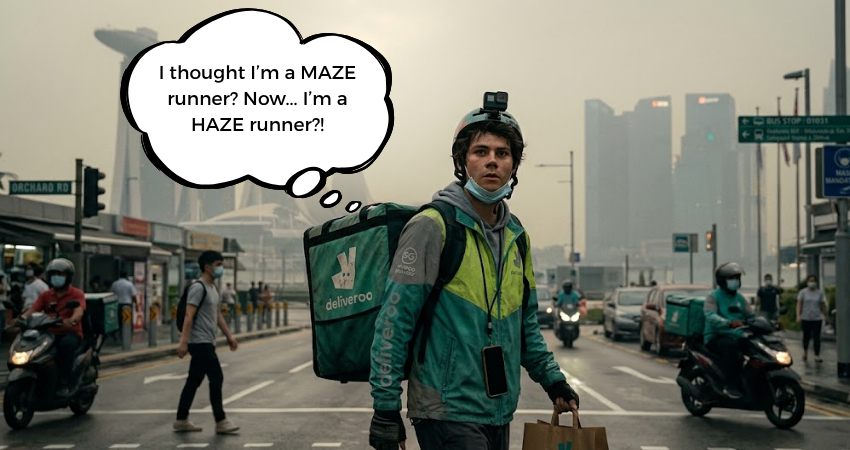
Imagine you’re Thomas from Maze Runner, trying to find your way through a maze with danger lurking around every corner.
Now, imagine that instead of towering walls and creepy creatures, your biggest obstacle is a thick blanket of haze covering the city.
Your morning jog is cancelled, workers are hesitating to go to work, and businesses are now pressured on what to do to keep things running.
Unlike Thomas, Singaporeans cannot simply find an exit and leave everything behind…not for businesses in which every dollar counts.
The haze now raises an important question: When the skies turn grey, how should Singapore businesses respond?
Singapore’s Haze Situation
Singapore’s haze problem is linked to forest and vegetation fires in neighbouring Indonesia, particularly Sumatra and Kalimantan.
Dry weather and unfavourable winds allowed smoke to drift across the region towards Singapore.
Based on the latest report of the National Environment Agency (NEA, 2026), Singapore recorded 24-hour Pollutant Standard Index (PSI) readings of 121-186 (unhealthy).
For different stakeholders, this raises concerns about outdoor activities, public health, and business operations.
From a Resource-Based View (RBV) perspective, businesses need employees and strong stakeholder relationships to maintain operational resilience amidst crisis.
Haze as a Business Management Issue
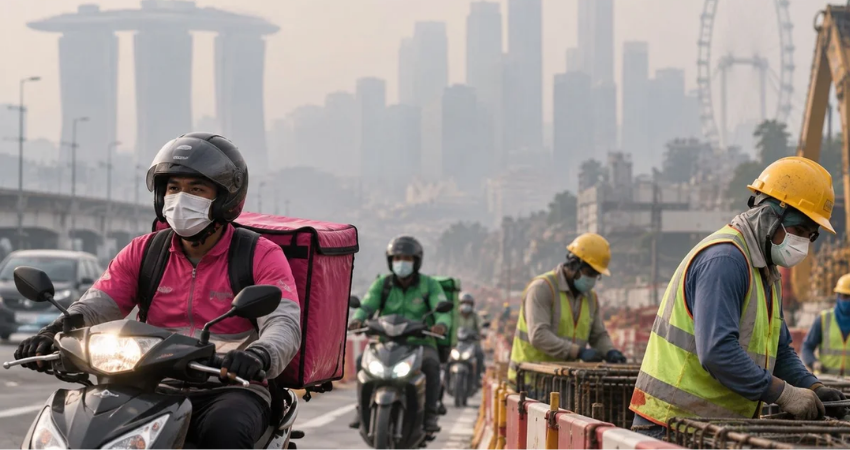
The haze is not just an environmental problem; it is also a challenge for many businesses.
Many firms may experience operational disruptions, lower customer demand, and employee safety concerns.
In a recent report by CNA, hawkers and alfresco dining outlets experienced a 60% decrease in total sales since the haze started in Singapore (Lee et al., 2026).
This is similar to the 2015 transboundary haze crisis, where Singapore suffered approximately S$1.83 billion in costs, affecting businesses, tourism, and households (Quah et al., 2021).
Therefore, businesses are pressured to balance operational continuity with their responsibilities to employees, customers, and other stakeholders.
Applying Mendelow’s Matrix
For business or social studies students, you may be familiar with the concept of stakeholder management and different frameworks.
One theory relevant to this is the Mendelow’s Matrix, which groups stakeholders based on two dimensions: Power and Interest (Chiwala et al., 2025).
This matrix is commonly used in business strategy, project management, and organisational decision-making to group stakeholders and determine the best engagement strategies.
Unlike typical tools like SWOT and PESTLE, this model is more relevant when you want to identify key stakeholders and effectively manage them.
In this haze-related business dilemma, power pertains to a stakeholder’s ability to influence a business decision in response to haze.
Meanwhile, interest is viewed as the extent to which a stakeholder is affected by, or concerned about business decisions.
To provide a clear mental picture, imagine a Singapore-based food delivery business deciding whether to adjust delivery operations during a severe haze episode.
The image below shows the different stakeholders based on their levels of power and interest.
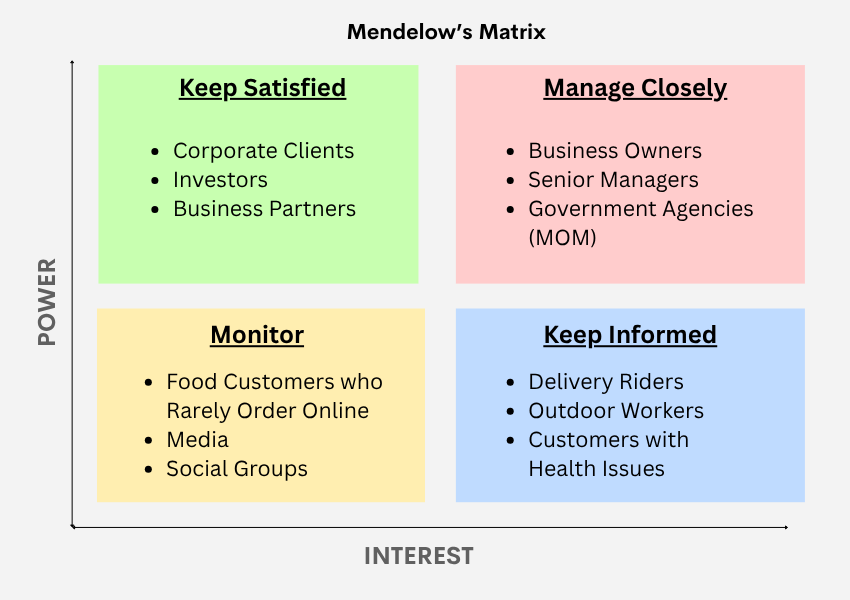
Manage Closely (High Power, High Interest)
This group includes business owners, senior managers, and relevant government authorities.
Business leaders have the power to decide whether to modify operations, introduce flexible working arrangements, or suspend certain activities.
Their interest is high because these decisions can impact employee welfare, operating costs, service quality, and corporate reputation.
For government authorities, they can significantly influence workplace safety requirements and public-health programmes.
So, if your employers or senior managers are not aware, you may need to send them the guidelines provided by the Ministry of Manpower to mitigate haze-related risks (MOM, 2026).

What should businesses do?
Business owners and managers should:
- Monitor air-quality advisories
- Prepare contingency plans
- Communicate decisions clearly
- Consult with relevant government agencies when necessary
Keep Satisfied (High Power, Low Interest)
Consider major corporate clients, investors, or business partners whose contracts and financial resources influence the implementation of company activities.
While they have considerable bargaining power, they have limited day-to-day interest in the health and safety of individual delivery riders.
Of course, unless the haze begins affecting service performance and profits, they are not highly concerned about a rider’s respiratory disease.
For example, a major client may expect deliveries to continue on schedule.
Its commercial influence could pressure the platform to continue its services despite Singapore’s hazy environment.

What should businesses do?
The management should:
- Keep these stakeholders informed about operational changes
- Discuss essential safety measures
- Explain that financial concerns should not outweigh employee wellbeing
Keep Informed (Low Power, High Interest)
This group highlights people who may have limited influence over company-wide decisions but are directly affected but them.
Specifically, delivery riders, outdoor workers, and customers with health issues are important examples.
Imagine when you’re craving Hainanese Chicken rice and decided to order online.
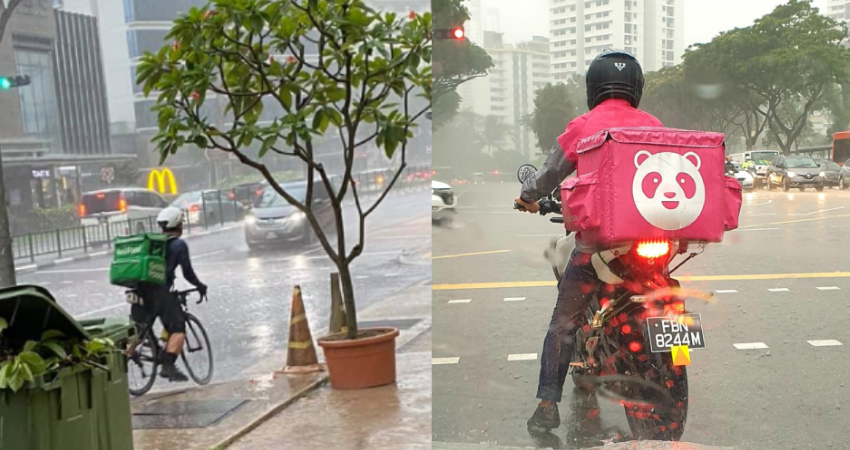
The delivery rider may spend hours outdoors while navigating traffic and carrying multiple orders.
These workers have a strong interest in decisions about working arrangements or protective equipment, but may have little say over platform policies.
Also, as a customer ordering online, you may be concerned about exposure and whether businesses ensure food safety measures.
What Should Businesses Do?
The management must:
- Consult workers before finalising work arrangements
- Provide clear channels for reporting symptoms
- Explain potential health risks and mitigation plans
- Reassure that workers can earn while ensuring their safety
Monitor (Low Power, Low Interest)
These people have little direct involvement in business decision-making and are not immediately affected by decisions.
For example, your father or grandparents who rarely use food delivery may have little concern about the platform’s temporary delivery arrangements.
Additionally, the media must also be monitored, as they can eventually impact company reputation, despite low power and interest in business decisions.
What should businesses do:
Business leaders must:
- Monitor changes in stakeholder concerns about work arrangements
- Provide relevant updates
- Ensure timely response in case of incidents
The Haze of the Matrix: Is Everyone Being Heard?
While Mendelow’s Matrix is useful, it has a limitation that business leaders must consider.
Power and interest do not necessarily reflect how much a stakeholder deserves to be heard.
Going back to our food delivery case example, a delivery rider may have limited influence over company policies even if he is directly exposed to the hazy environment.
If businesses focus only on stakeholders who can affect profits, the workers who are more vulnerable to haze-related risks can be overlooked.
This is why the concept of “Happiness Management” is important, as it considers the relationship between business owners and the affected groups (Mu et al., 2024).
Basically, to ensure stakeholder happiness, leaders must consider the overall wellbeing of every individual, through proactive communication and response to their needs.
Finding Your Way Through the Haze
Given the challenges brought by the haze, the Mendelow’s Matrix offers a practical starting point for businesses.
Business leaders can identify who has influence, who are highly concerned or affected, and how each group should be engaged.
Nonetheless, managing stakeholders is not about keeping the powerful groups satisfied.
Individuals who have less influence must also be heard and involved in decision-making.
After all, the business’s real test is not just whether it can keep running—it is whether it can maintain people’s happiness despite a hazy situation.
References:
Chiwala, B., Makasa, M., & Zulu, J. M. (2025). Power and interest levels in safely managed sanitation services in Zambia: A stakeholder mapping. PLoS One, 20(11), e0335130. https://doi.org/10.1371/journal.pone.0335130
Lee, L., Zalizan, T. & Jacob C. (2026, October 14). Spike in PM2.5 in Singapore catches people off guard, haze hits businesses and outdoor workers. Channel News Asia. https://www.channelnewsasia.com/singapore/haze-pm25-psi-businesses-outdoor-workers-poor-air-quality-6459106
Ministry of Manpower. (2026). Guidelines for employers on protecting employees from the effect of haze. https://www.mom.gov.sg/haze/guidelines-on-protecting-employees-from-haze
Mu, H. L., Xu, J., & Chen, S. (2024). The impact of corporate social responsibility types on happiness management: a stakeholder theory perspective. Management Decision, 62(2), 591-613. https://doi.org/10.1108/MD-02-2023-0267
National Environment Agency. (2026). Haze situation update. https://www.haze.gov.sg/
Quah, E., Chia, W. M., & Tan, T. S. (2021). Economic impact of 2015 transboundary haze on Singapore. Journal of Asian Economics, 75, 101329. https://doi.org/10.1016/j.asieco.2021.101329

About Nick
Nick loves the written word. He spends part of his days wondering how to combine his two loves, writing and traveling. The rest of his time he spends having a little wine with friends along Siglap.
You must be logged in to post a comment.